

Why “Gaining an Hour” Still Leaves You Exhausted
Sunday morning, you woke up to the best deal of the year: an extra hour of sleep, handed to you by the clock change, absolutely free. You grinned at the clock, rolled over, and drifted back into a warm, unearned dream.
And then Monday morning arrived — and you felt like you had flown across three time zones in your sleep.
No jet lag. No travel. No excuse. Just a strange, heavy grogginess that coffee barely touched. If the clocks gave you an hour back, why does your whole body feel like it is owed money?
Because the hour you gained was a paperwork change. Your body never signed off on it.
Your Brain Does Not Run on Clocks
Deep inside your brain, sitting right above where your optic nerves cross, there is a tiny cluster of neurons called the suprachiasmatic nucleus. It is your body’s master clock, and it is spectacularly unimpressed by government time changes.
This master clock does not read clocks. It reads light.
Every day, light hitting your eyes tells it where you are in the 24-hour cycle: sunrise means morning cortisol, evening darkness means melatonin. This cycle — your circadian rhythm — runs on its own stubborn schedule, and it can only be nudged, not flipped. Research shows it shifts roughly an hour a day at most, and only when given the right light cues.
So when the clock suddenly moved an hour on Sunday, your master clock kept running yesterday’s program. You woke up “on time” by the clock, but your brain was still on last week’s schedule. That mismatch is exactly what jet lag is — only instead of crossing time zones, time itself moved under your feet.
The Extra Hour Was a Trade, and You Lost
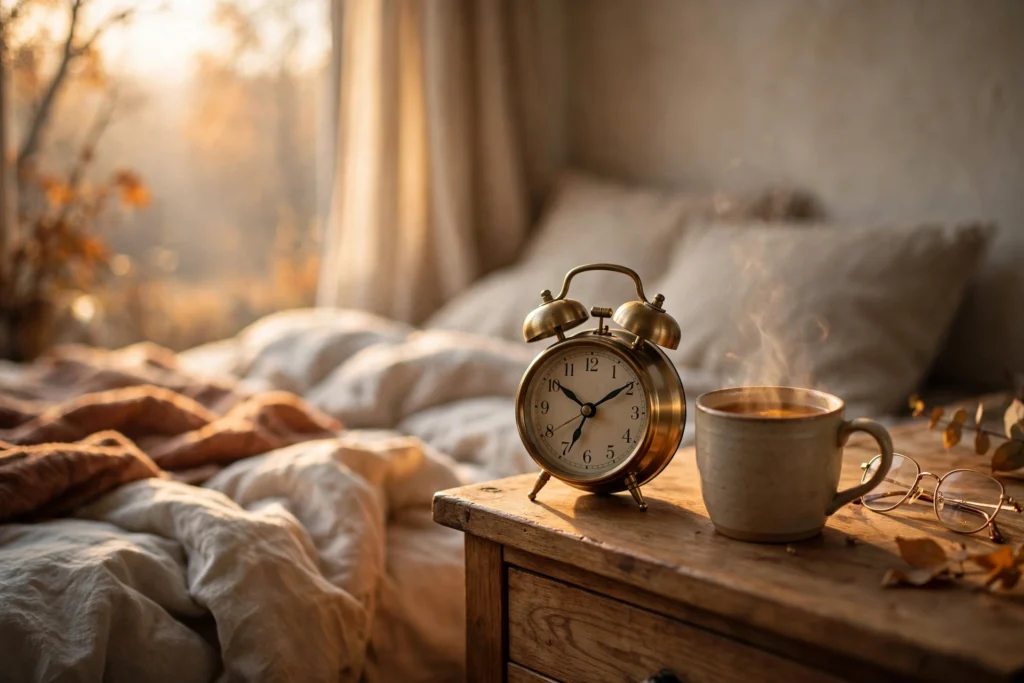
Here is the part nobody mentions while celebrating the “extra hour”: you did not just gain a morning. You lost an evening.
Clocks fell back, which means sunrise now arrives an hour earlier — but so does sunset. That sudden early darkness is the real troublemaker. Your brain, which has been carefully learning the old sunset pattern for months, now gets its melatonin signal — the “time to wind down” chemical — a full hour earlier than it expects.
So your body starts getting sleepy when you are still trying to be awake, and then — cruel twist — your alarm wakes you during a deeper phase of sleep than usual, because your rhythm has not caught up yet. You went to bed feeling drowsy at 8 p.m. and woke up at 6:30 a.m. feeling like the night was stolen from you.
Gaining an hour of sleep and losing an hour of light turned out to be a bad exchange.
The Groggy Week Is Your Body Renegotiating
That sluggish, foggy feeling that lingers for days after the change is not laziness. It is literally your organs arguing with each other.
Your master clock may adjust within a day or two, but your body’s other clocks — in your liver, your gut, your skin — run slightly behind, and they all need to resync with each other too. Until they do, your cortisol spikes at the wrong time, your digestion feels off, and your brain’s “sharp hours” land somewhere in the middle of the afternoon, right when meetings are scheduled.
This is also why the week after the clock change tends to feel heavier emotionally. Earlier darkness alone is enough to lower mood — it is the same mechanism behind the winter blues, arriving all at once instead of gradually. Your brain had weeks to adjust to shorter days naturally. The time change dumped it on you overnight.
Some People Never Notice — and It Is Not Fair
If you sailed through the change without a yawn, do not feel smug — check your genes. Chronotype — whether you are naturally a morning lark or a night owl — is partly inherited, and it changes how hard the shift hits.
Morning people generally adjust faster to the fall-back change, because earlier light agrees with their wiring. Night owls get it worse: their master clocks were already fighting the schedule, and the change adds another hour of disagreement.
Age matters too. Children’s and teenagers’ rhythms are notoriously stubborn — which is why the fall-back week often comes with cranky kids who are wide awake at what is suddenly 9 p.m., and pets who stare at their empty food bowls an hour early, completely baffled by your betrayal.
And yes — the pets are not wrong. Your dog’s stomach clock never heard about daylight saving. In a way, the dog is the most honest one in the house.
Practical Takeaways
- Get morning light on purpose. A walk or even sitting near a bright window in the first hour after waking tells your master clock the new schedule faster than anything else.
- Keep your wake time sacred. Sleeping in this week feels good and backfires — a consistent wake time is the strongest signal you can give your body clock.
- Resist the heroic nap. A long afternoon nap resets nothing and steals your nighttime sleep. If you must nap, keep it under 20 minutes.
- Dim the evenings. Bright overhead lights at night tell your brain it is still afternoon. Softer light after dinner helps your melatonin arrive on the new schedule.
- Give it a week, not a day. Your rhythm needs 3 to 5 days to fully settle. The grogginess is a process, not a problem — it ends on its own.
So the next time someone chirps “but you GAINED an hour!” while you are yawning through your morning meeting, you can smile knowingly. The hour went to your clock. The exhaustion went to your brain. And somewhere deep inside, a tiny cluster of neurons is still running last week’s schedule, completely ignoring the official time — exactly the way nature designed it to.