

Why You See Faces in Clouds, Toast, and Random Objects (and What It Says About Your Brain)
You are lying on the grass on a lazy afternoon when you look up and there it is: a cloud with two dark patches for eyes and a curve underneath that is unmistakably a smile. You know it is just water vapor. You know it has no feelings and no face at all. And yet your brain insists, with total confidence, that the cloud is looking back at you.
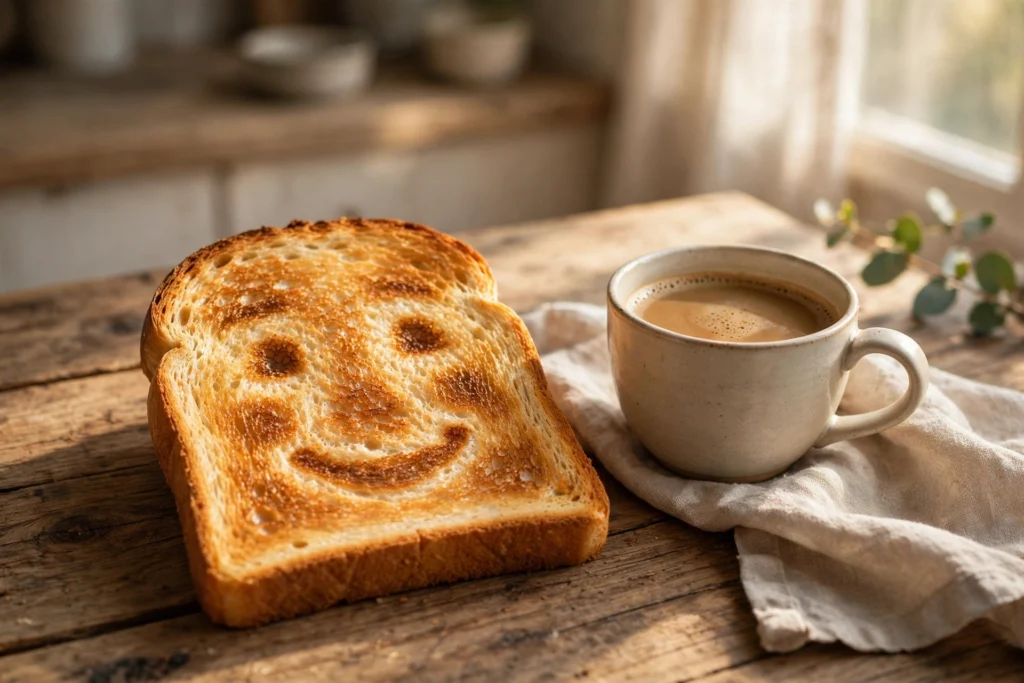
You are not imagining things. You are experiencing one of the oldest tricks your brain knows — a phenomenon called pareidolia, from the Greek words for “beside” and “image.” It is the reason people see the Virgin Mary on a piece of toast, a face on the moon, and a grinning socket on a wall. And far from being a glitch, it is one of the clearest windows into how your mind actually works.
Your Brain Is a Face-Detecting Machine
Human beings are born face-hunters. Newborn babies, barely hours old, will stare longer at a simple drawing of two dots above a line — a face — than at the same shapes scrambled into nonsense. We do not learn this preference. We arrive with it.
There is a good reason. For most of human history, the single most important thing in your environment was another person’s face. A face told you, in a fraction of a second, whether someone was a friend or a threat, happy or furious. Missing a real face could cost you everything. Mistaking a rock for a face cost you nothing.
So evolution tuned your brain to be trigger-happy. Deep inside it sits a patch of tissue called the fusiform face area, so specialized that it lights up the moment anything even vaguely face-shaped enters your vision. It does not wait for proof. Two dots and a curve? Close enough. Face detected.
Why the Moon Smiles and Toast Preaches
Once your brain flags something as a face, something even stranger happens: it starts treating it like a person. You do not just see two eyes in an electrical socket — you feel that the socket looks surprised. The front of a car does not just resemble a face — it looks friendly, or angry, depending on the shape of its headlights.
The moment your brain spots a face, it starts reading emotion into it, assigning it a mood, even a personality. That is why a house with two round windows and a door can look cheerful on a sunny day and ominous at dusk, without a single thing about the house changing.
It also explains why the most famous pareidolia sightings are always faces of someone important. When a grilled-cheese sandwich appears to carry the image of a holy figure, it is not the toast doing the work. It is your brain, matching blurry shapes to the most meaningful face it already knows.
The Price of a Hair-Trigger Alarm
A system this eager makes mistakes — and those mistakes are fascinating. Your brain would rather see a hundred false faces than miss one real one. Psychologists call this a “false positive” bias, and it is the same logic that makes a smoke alarm go off when you burn toast. Annoying? Yes. But you would never trade it for an alarm that stays silent during a real fire.
This bias shows up everywhere, not just in faces. It is why you hear your name in a crowd when nobody said it, and why a creaking house at night sounds like footsteps. Your brain is not a perfect recorder of reality. It is a guesser — fast, confident, slightly paranoid — and it would rather warn you about something that is not there than stay quiet about something that is.
What Your Face-Spotting Says About You
How strongly you experience pareidolia says something about how your brain is wired. People who are more socially tuned in — who read emotions easily and notice small changes in a friend’s expression — tend to see faces in objects more readily. So do people in a good mood. A cheerful brain is a more generous pattern-finder.
Children see faces everywhere, which is why a stuffed animal is never just a toy. And the effect never really goes away. It just gets quieter as you get older — still there, if you know how to look.
Some scientists believe pareidolia is part of why we are so good at art and storytelling. A brain that can see a face in a cloud is a brain that can see a story in a stranger. The same wiring that makes you smile at a happy-looking car is the wiring that lets you imagine what someone else is feeling. It is empathy, in its earliest, rawest form.
A Trick Worth Keeping
So the next time you catch a face in your morning toast, do not laugh it off as a silly mistake. Your brain just showed you its favorite trick: taking a random arrangement of shadows and turning it into something alive, something almost human.
It did that because, for your ancestors, a face was the most important thing in the world. It still is. The faces you love, the faces you trust, the faces you would recognize in any crowd — your brain learned to find them by practicing on everything else first. Clouds included.
Look up. The sky is full of faces. That is not a flaw in how you see the world. It is the reason you see it so richly.
Practical Takeaways
- Notice it happening: the next time you spot a face in an object, pause and look — you are watching your brain’s face-detection system fire in real time.
- Use it as a creativity tool: pareidolia is your brain finding patterns, so sketching and storytelling get easier when you let that pattern-finder run free.
- Know the false alarms are normal: seeing faces where none exist is not a sign of anything wrong — it is a sign of a healthy, socially tuned brain doing what it evolved to do.
- Watch your mood: you will spot more faces when you are relaxed and happy, because a calm brain is more generous with its pattern-matching.
- Show a child: kids see faces everywhere, and sharing that wonder with them reminds you how magical ordinary seeing really is.
- Remember the upside: the same wiring that finds faces in clouds also helps you read the people you love — it is empathy, practicing on the world around you.